In short
Shardiya Navratri 2026 runs from Sunday, October 11 to Maha Navami on Monday, October 19, with Dussehra on Tuesday, October 20. Ghatasthapana is approximately 6:19 AM to 10:12 AM IST, but Chitra Nakshatra and Vaidhriti Yoga cover the whole day, so Abhijit Muhurat, 11:44 AM to 12:31 PM IST, is the stricter choice in India - in the USA and Canada Pratipada ends before noon, so install the Kalash in the morning. Saptami falls on two days in India, so Durga Ashtami is October 19 there and October 18 in the USA, Canada and the UK.
Shardiya Navratri 2026 begins on Sunday, October 11 and ends with Vijayadashami on Tuesday, October 20. Every calendar will give you the Ghatasthapana window of 6:19 AM to 10:12 AM and leave it there. There are two things worth knowing that those listings omit. The first is technical: both Chitra Nakshatra and Vaidhriti Yoga - the two conditions classically avoided for Kalash Sthapana - run across the whole of October 11 this year, which means the standard morning window is not as clean as it looks and the Abhijit Muhurat becomes the more defensible choice. The second is astrological: in Jyotish, Durga is the deity invoked to control Rahu, and Rahu leaves Aquarius on December 5, 2026 when the nodal axis shifts to Capricorn-Cancer. This is therefore the last Navratri of the current Rahu cycle, and the nine nights fall in the closing stretch when remedies aimed at an unsettled Rahu carry the most weight. This guide gives the exact muhurats, resolves the Chitra-Vaidhriti question, sets out the nine-day calendar with colours and Navadurga forms, covers Durga Puja, Sandhi Puja and the Dussehra Vijay Muhurat, and lists the Rahu remedies genuinely worth performing in the window that remains.
Navratri 2026 Date and Ghatasthapana Muhurat (Kalash Sthapana Time)
Shardiya Navratri 2026 opens with Ghatasthapana on Sunday, October 11 and runs to Maha Navami on Monday, October 19. Vijayadashami - Dussehra - falls on Tuesday, October 20. One detail changes the back half of the calendar: Saptami tithi lasts more than twenty-six hours and is present at sunrise in India on both October 17 and 18, so Saptami is kept on two days and Durga Ashtami moves to Monday, October 19 - the same day Navami begins. In the USA, Canada and the UK there is no doubling, and Ashtami there falls on Sunday, October 18.
Ghatasthapana must be performed while Pratipada tithi is running and, by the classical rule, before Hindu midday - ideally in the first one-third of the day. Pratipada begins at approximately 9:20 PM on October 10 and ends at approximately 9:32 PM on October 11, so the tithi covers the whole of the 11th. City-level sunrise differences move these windows by up to an hour within India, and by hours abroad, so confirm against your local Panchang before fixing the exact minute.
| Observance | Date | Timing (IST) |
|---|---|---|
| Ghatasthapana / Navratri Day 1 | Sunday, October 11, 2026 | Morning muhurat approximately 6:19 AM to 10:12 AM (New Delhi) |
| Abhijit Muhurat (alternative) | Sunday, October 11, 2026 | Approximately 11:44 AM to 12:31 PM (New Delhi) |
| Pratipada tithi | October 10 to 11 | 9:20 PM Oct 10 to 9:32 PM Oct 11 |
| Saptami (kept on two days) | Saturday, October 17 and Sunday, October 18 | 5:55 AM Oct 17 to 8:29 AM Oct 18 |
| Durga Ashtami | Monday, October 19 (Sunday, October 18 in the USA, Canada and UK) | Ashtami ends 10:52 AM; Kanya Pujan before then |
| Sandhi Puja | Monday, October 19 | 10:28 AM to 11:16 AM (Bisuddha Siddhanta) or about 7:26 AM to 8:14 AM (Gupta Press) |
| Maha Navami | Monday, October 19 | Navami tithi 10:52 AM Oct 19 to 12:51 PM Oct 20 |
| Vijayadashami / Dussehra | Tuesday, October 20, 2026 | Vijay Muhurat approximately 1:59 PM to 2:44 PM (New Delhi) |
| Navratri parana (breaking the fast) | Tuesday, October 20, 2026 | After 12:51 PM |
The Chitra-Vaidhriti Problem: Why the Morning Window Is Not Straightforward This Year
This is the detail that separates a real muhurat reading from a copied calendar entry. Two conditions are classically set aside for Ghatasthapana: Chitra Nakshatra and Vaidhriti Yoga. In 2026 both of them sit across the entire Ghatasthapana day. Chitra runs from approximately 9:42 PM on October 10 to 10:32 PM on October 11. Vaidhriti Yoga runs from approximately 10:02 PM on October 10 to 9:05 PM on October 11. There is no part of the morning window that escapes either.
The correct reading of the classical position matters here, because it is routinely overstated. Chitra and Vaidhriti are to be avoided for Kalash Sthapana - they are not an absolute prohibition that voids the ritual. When they cannot be avoided, and in 2026 they cannot, the tradition provides the standard fallback: perform Ghatasthapana during Abhijit Muhurat, the short window straddling local noon that is held to override ordinary adverse combinations.
So the practical answer for 2026 is this. If you want the strictest observance, install the Kalash between approximately 11:44 AM and 12:31 PM IST in Abhijit Muhurat. If household or temple custom fixes the morning, the 6:19 AM to 10:12 AM window remains valid and widely used - it is Pratipada, it is in the first third of the day, and that is the primary requirement. What you should not do is push Ghatasthapana past Hindu midday for any reason other than Abhijit, or defer it to the second day.
| City | Morning Ghatasthapana window | Abhijit Muhurat |
|---|---|---|
| New Delhi | Approximately 6:19 AM to 10:12 AM IST | Approximately 11:44 AM to 12:31 PM IST |
| Mumbai | 6:31 AM to 10:27 AM IST | 12:01 PM to 12:48 PM IST |
| Kolkata | 5:31 AM to 9:25 AM IST | 10:59 AM to 11:46 AM IST |
| Ahmedabad | 6:34 AM to 10:29 AM IST | 12:02 PM to 12:49 PM IST |
| Dubai | 6:15 AM to 10:08 AM | 11:42 AM to 12:28 PM |
| London | 7:17 AM to 10:57 AM BST | 12:24 PM to 1:08 PM BST |
| New York & New Jersey | 7:03 AM to 10:49 AM EDT | Not available - Pratipada ends 12:02 PM EDT |
| Sydney | 6:19 AM to 10:34 AM AEDT | 12:16 PM to 1:07 PM AEDT |
Chitra and Vaidhriti are a reason to choose your muhurat carefully in 2026, not a reason to skip the Kalash. The tradition already answered this: when both are unavoidable, Abhijit decides.
- Chitra Nakshatraapproximately 9:42 PM Oct 10 to 10:32 PM Oct 11 - covers the full day
- Vaidhriti Yogaapproximately 10:02 PM Oct 10 to 9:05 PM Oct 11 - covers the full day
- Classical statusto be avoided, not absolutely prohibited
- Prescribed fallbackAbhijit Muhurat, approximately 11:44 AM to 12:31 PM IST
- Primary rule that still governsPratipada tithi, before Hindu midday, first third of the day preferred
- Not acceptablepostponing Ghatasthapana to Dwitiya to dodge the nakshatra
Navratri 2026 Calendar: 9 Days, Goddesses and Colours Day by Day
Each of the nine nights is assigned to one form of the Navadurga, and each day carries a traditional colour worn during worship. The colour sequence is set by the weekday on which Navratri opens, which is why it changes year to year - 2026 begins on a Sunday, giving orange as the first day. Colours follow the civil date, while each goddess follows her tithi, so in India the two drift apart after the doubled Saptami: purple is worn on October 18, but Mahagauri's Ashtami puja is on October 19. Each day has its own detailed guide with puja vidhi, mantra, bhog and timings for cities abroad.
Fasting practice varies legitimately. Some observe all nine days on a single satvik meal, some keep only the first and last day, and some observe Ashtami or Navami alone. The tradition treats all three as valid; what it does not treat as optional is consistency once you have made the sankalpa on day one.
| Day and date | Tithi | Goddess (graha) | Colour (by date) | Bhog |
|---|---|---|---|---|
| Day 1 - Sun, Oct 11 | Pratipada - Ghatasthapana | Maa Shailaputri (Moon) | Orange | Pure cow ghee |
| Day 2 - Mon, Oct 12 | Dwitiya | Maa Brahmacharini (Mars) | White | Sugar or mishri |
| Day 3 - Tue, Oct 13 | Tritiya | Maa Chandraghanta (Venus) | Red | Milk kheer |
| Day 4 - Wed, Oct 14 | Chaturthi | Maa Kushmanda (Sun) | Royal blue | Malpua |
| Day 5 - Thu, Oct 15 | Panchami | Maa Skandamata (Mercury) | Yellow | Bananas |
| Day 6 - Fri, Oct 16 | Shashthi - Durga Puja Bodhon in Bengal | Maa Katyayani (Jupiter) | Green | Honey |
| Day 7 - Sat, Oct 17 | Saptami | Maa Kalaratri (Saturn) | Grey | Jaggery |
| Day 7 (cont.) - Sun, Oct 18 | Saptami continues in India (Ashtami in the USA, Canada and UK) | Maa Kalaratri (Saturn) | Purple | Jaggery |
| Day 8 - Mon, Oct 19 | Ashtami until 10:52 AM IST - Kanya Pujan, Sandhi Puja | Maa Mahagauri (Rahu) | Peacock green | Coconut |
| Day 9 - Mon, Oct 19 | Navami from 10:52 AM IST - havan that afternoon or before 12:51 PM Oct 20 | Maa Siddhidatri (Ketu) | Peacock green | Sesame (til) |
| Day 10 - Tue, Oct 20 | Dashami - Vijayadashami, Visarjan, Ravan Dahan, Shami Puja | - | - | - |
Navratri 2026 Dates in the USA, UK, Canada, Australia and Singapore
Ghatasthapana falls on Sunday, October 11 in every country this year, because Pratipada is present at sunrise everywhere. After that the calendars separate. Each Hindu festival day is fixed by the tithi present at local sunrise, and several tithis in 2026 last more than twenty-five hours, so the same tithi can touch two sunrises in one country and only one in another.
In India and the UAE, Saptami covers two sunrises and Durga Ashtami moves to Monday, October 19. In the USA, Canada and the UK there is no doubling, so Ashtami is Sunday, October 18. In Kolkata and Singapore the doubling falls earlier, on Shashthi; in New Zealand on Tritiya; in Sydney and Melbourne on Chaturthi; in Perth on Panchami. Saptami there is therefore October 18 alone and Ashtami October 19. In Sydney, Melbourne and New Zealand Dashami begins only on the evening of October 20, so Dussehra moves to Wednesday, October 21. In Singapore and Perth it begins at 3:21 PM local time on October 20, so temples there may keep either day.
For Ghatasthapana itself, the difference that matters most is in North America. Pratipada ends at 12:02 PM EDT and 9:02 AM PDT on October 11, so the Abhijit fallback is not available anywhere in the USA or Canada and the Kalash must be installed in the morning. Each day's guide in this series gives the timings for its own day, computed from local sunrise for 20 cities.
- India and UAEGhatasthapana Sun, Oct 11; Saptami Oct 17 and 18; Durga Ashtami Mon, Oct 19; Maha Navami Mon, Oct 19; Dussehra Tue, Oct 20
- USA and CanadaGhatasthapana Sun, Oct 11; Saptami Sat, Oct 17; Durga Ashtami Sun, Oct 18; Maha Navami Mon, Oct 19; Dussehra Tue, Oct 20
- UK and EuropeGhatasthapana Sun, Oct 11; Saptami Sat, Oct 17; Durga Ashtami Sun, Oct 18; Maha Navami Mon, Oct 19; Dussehra Tue, Oct 20
- Singapore and PerthGhatasthapana Sun, Oct 11; Saptami Sun, Oct 18; Durga Ashtami Mon, Oct 19; Maha Navami Tue, Oct 20; Dussehra borderline - Oct 20 after 3:21 PM or Oct 21 for the full Vijay Muhurat
- Sydney, Melbourne and New ZealandGhatasthapana Sun, Oct 11; Saptami Sun, Oct 18; Durga Ashtami Mon, Oct 19; Maha Navami Tue, Oct 20; Dussehra Wed, Oct 21
Durga, Rahu and Why Navratri 2026 Is Different
In Jyotish every graha has deities attached to it at different levels, and Durga is the one invoked against Rahu. She is described in the remedial literature as the controller of Rahu - the shadow graha that governs obsession, illusion, foreign matters, sudden unearned rise and equally sudden exposure. This is not a decorative association: recitation of the Durga Saptashati is the standard prescription for an afflicted Rahu, which is precisely why Navratri is the strongest annual window for that remedy.
Rahu's difficult signature is recognisable once named. Ambition that outruns capacity. Confusion in matters that ought to be clear. Deception, addiction, obsessive attachment to a person or an outcome, and reputations built fast on ground that will not hold. Its constructive face is equally real - unconventional intelligence, foreign opportunity, technology, mass reach, and the willingness to attempt what a cautious chart would never try.
What makes 2026 specific is timing. Rahu has occupied Aquarius since May 2025 alongside Ketu in Leo, and on December 5, 2026 the axis shifts to Capricorn-Cancer for the next eighteen months. Navratri from October 11 to 20 is therefore the final Navratri of this nodal cycle, landing in its closing weeks. In remedial practice, the end of a graha's transit through a sign is when unfinished business with that graha is settled - which makes this year's Durga sadhana better placed than any Navratri for the next eighteen months.
- Durga's grahaRahu, the north lunar node
- Rahu's difficult signatureillusion, obsession, deception, addiction, sudden exposure, borrowed ambition
- Rahu's constructive signatureforeign gain, technology, unconventional intelligence, mass visibility
- Current transitRahu in Aquarius since May 2025, moving to Capricorn on December 5, 2026
- Why it matters nowthe last Navratri of the Aquarius-Rahu cycle
- Most affectedanyone running a Rahu Mahadasha or Antardasha, and Aquarius and Leo natives carrying the nodal axis directly
- Companion remedyKetu work through Ganesha, which closes on the same December 5 date
How Bengal's Durga Puja Calendar Differs in 2026
In Bengal, Assam, Odisha and the eastern diaspora, the same nine nights are observed as Durga Puja and the ritual weight sits in the last five days rather than spread across all nine. Bengal's pujas in 2026 run from Bodhon on the evening of Friday, October 16 to Bijoya Dashami on Wednesday, October 21. The two Bengali panjika traditions differ this year: by the Gupta Press and Benimadhab Shil panjikas Saptami is present at two sunrises, October 17 and 18, while by the Bisuddha Siddhanta panjika it is October 18 alone. Both agree on Ashtami on October 19.
The most time-sensitive item in the entire festival is Sandhi Puja. It occupies the junction of Ashtami and Navami - the last twenty-four minutes of Ashtami tithi and the first twenty-four minutes of Navami - a single forty-eight minute window that cannot be moved. In 2026 it falls on Monday, October 19, but the time depends on the panjika. By the Bisuddha Siddhanta panjika and modern astronomical calculation, Ashtami ends at 10:52 AM IST and Sandhi Puja runs from 10:28 AM to 11:16 AM IST. By the Gupta Press panjika, followed by many Kolkata pandals, Ashtami ends at 7:49 AM and Sandhi Puja runs from about 7:26 AM to 8:14 AM IST. Follow the niyomaboli of your own pandal or temple.
- Maha ShashthiFriday, October 16, 2026 - Bodhon, Amantran and Adhivas in the evening
- Maha SaptamiSaturday, October 17 and Sunday, October 18 (Gupta Press), or Sunday, October 18 (Bisuddha Siddhanta) - Nabapatrika Snan at dawn
- Maha AshtamiMonday, October 19, 2026 - Ashtami Anjali, Kumari Puja, Kanya Pujan
- Sandhi PujaMonday, October 19 - 10:28 AM to 11:16 AM IST (Bisuddha Siddhanta) or about 7:26 AM to 8:14 AM IST (Gupta Press)
- Maha NavamiTuesday, October 20, 2026 in Bengal - Navami Homa (Monday, October 19 in North Indian calendars)
- Bijoya DashamiWednesday, October 21, 2026 in Bengal - Sindoor Khela, Visarjan
- Dussehra (North & West India)Tuesday, October 20 - Vijay Muhurat approximately 1:59 PM to 2:44 PM IST in Delhi, 2:19 PM to 3:06 PM in Mumbai
Ghatasthapana Vidhi and Samagri: How to Install the Kalash
The Kalash is the physical seat of the Goddess for nine days, and the sequence below is the standard household form. It is performed once, on day one, in the chosen muhurat - everything afterwards is daily worship around an installation that is not disturbed until Visarjan.
The barley sown under the Kalash, called Khetri or Jayanti, is read as an omen at the end of the nine days: dense even growth is taken as favourable, patchy or yellowed growth as an indication that the year needs more care. It is cut and distributed on Vijayadashami, not thrown away.
- Directioninstall in the north-east of the home, with the worshipper facing east or north-east
- Basea clay pot of soil, into which barley seeds are sown and lightly watered
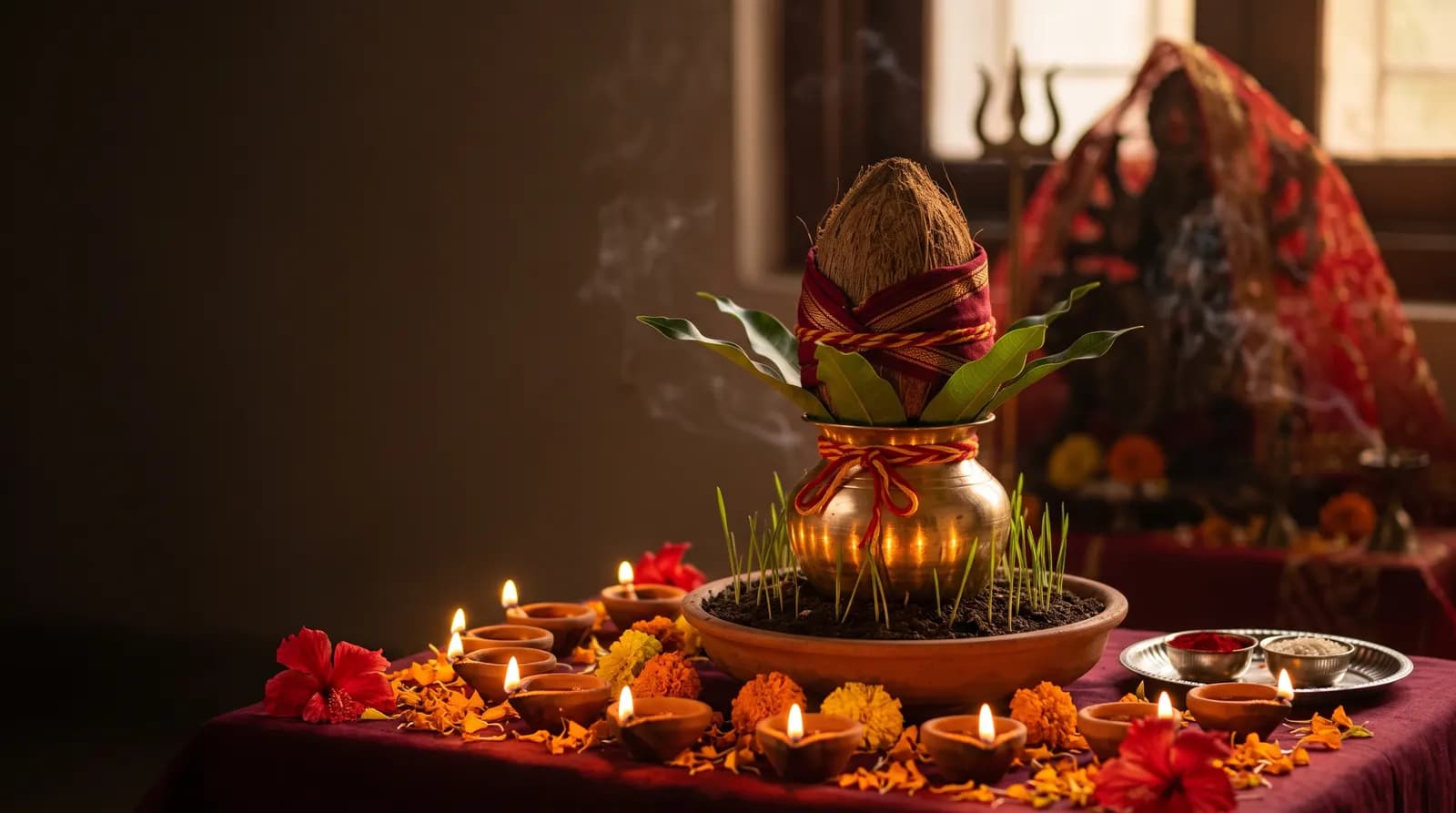
- Kalasha copper or brass pot filled with clean water, a coin, whole betel nut, akshat and durva placed inside
- Mouthfive mango or ashoka leaves arranged at the rim, topped with an unpeeled coconut wrapped in red cloth
- Threadtie moli around the neck of the Kalash three times
- Invocationperform sankalpa stating the duration of your fast, then invoke Durga into the Kalash and light the Akhand Jyot if you intend to keep one
- Dailymorning and evening aarti, Durga Chalisa or Durga Saptashati path, and fresh water for the barley
- Do notmove the Kalash, let the Akhand Jyot go out, or leave the house empty of a worshipper at aarti time
Navratri Fasting Rules 2026: What to Eat and What to Avoid
The Navratri fast in 2026 runs from the sankalpa made at Ghatasthapana on Sunday, October 11 to parana after Navami. The tradition accepts three forms as equally valid: all nine days, the first and last day only, or Ashtami or Navami alone. What it treats as the real fault is breaking a declared vow casually, so choose a form you can keep before you make the sankalpa.
Parana, the breaking of the fast, is done after Navami tithi ends. In India that is after 12:51 PM IST on Tuesday, October 20, which is also Dussehra. Abroad Navami ends at a different local hour, and the Maha Navami guide in this series gives the parana time country by country. Families whose custom is to break the fast on Navami after the havan and Kanya Pujan may do so; the tradition accepts both.
- Allowed (vrat foods)fruit, milk and curd, sabudana, kuttu (buckwheat), singhara (water chestnut) and rajgira flour, potatoes, and sendha namak (rock salt)
- Avoidgrains, ordinary table salt, onion, garlic, meat, eggs and alcohol
- Healthpregnant women, diabetics and anyone on medication should keep a phalahar (fruit and milk) fast rather than a nirjala one
- Ashtami-only fastMonday, October 19 in India; Sunday, October 18 in the USA, Canada and the UK
- Akhand Jyotif you light one, keep someone at home and enough ghee or oil for it not to go out
- Kalash and barleywater the sown barley lightly every morning and do not move the Kalash until Visarjan
- Parana in Indiaafter 12:51 PM IST on Tuesday, October 20
Navratri 2026 Rahu Remedies: Durga Saptashati, Mantras and Charity
These are the classical prescriptions for pacifying Rahu through Durga worship. They are most relevant if you are running a Rahu period, if Rahu sits in an angle or trine in your chart, or if the Leo-Aquarius axis is prominent for you - but the nine nights themselves are appropriate for anyone, with or without an afflicted chart.
- Durga Saptashati paththe primary remedy; one chapter a day across the nine days, or the complete text on Ashtami if you can only do one sitting
- Argala Stotram and Kilakamrecited before and after the Saptashati, as the tradition requires rather than as an optional extra
- Durga Beej Mantra'Om Dum Durgayei Namaha', 108 times daily through the nine nights
- Rahu Beej Mantra'Om Bhram Bhreem Bhroum Sah Rahave Namah', 108 times on Saturday for those with Rahu prominent in the chart
- Kanya Pujan on Ashtamifeeding and honouring nine young girls, the single most emphasised act of the festival
- Charity for Rahudonate mustard oil, black sesame, a black blanket or urad dal; feed stray animals rather than making a display of the giving
- Akhand Jyotan unbroken lamp for nine nights is specifically prescribed against Rahu's confusion, since Rahu's signature is obscured perception
- End one illusionRahu rules what you have talked yourself into. Withdrawing from one commitment you have known for months is wrong is, in practice, the most aligned remedy of all
The takeaway
Navratri 2026 opens on Sunday, October 11 with Ghatasthapana from approximately 6:19 AM to 10:12 AM, and with Chitra Nakshatra and Vaidhriti Yoga covering the whole day, the Abhijit window of 11:44 AM to 12:31 PM is the stricter choice. Saptami falls on two days in India, so Durga Ashtami is Monday, October 19 (October 18 in North America and the UK), and the festival closes with Maha Navami on October 19 and Vijayadashami on October 20. Beyond the calendar, the timing carries real astrological weight this year: Durga is the deity invoked against Rahu, and these are the last nine nights before Rahu leaves Aquarius on December 5, 2026. If this cycle has brought you ambition that did not land, a confusion you could not name, or an attachment you could not explain, the remedies performed now fall in the closing window of the period that produced them. To find out exactly where Rahu sits in your own chart, whether you are running its Dasha, and which of these remedies applies specifically to you rather than generally, book a 1-on-1 video consultation with Astrologer Sheela Goklani.
Book my Rahu & Dasha reading